Enrollment isn’t open yet · Joining is free and commits you to nothing
Who it’s for
Students in years 1–3 studying anatomy for block and practical exams
Anyone who knows the names but gets lost on the injury question
Visual learners who want Arabic explanations with the English terms
Not for
Anyone looking for a replacement for lectures or practical training
Anyone who wants a “shortcut” that guarantees a pass
How it’s taught
Every region is built as a four-layer map
Map → Function → Lesion → Question. Try it on the nerves of the upper limb:
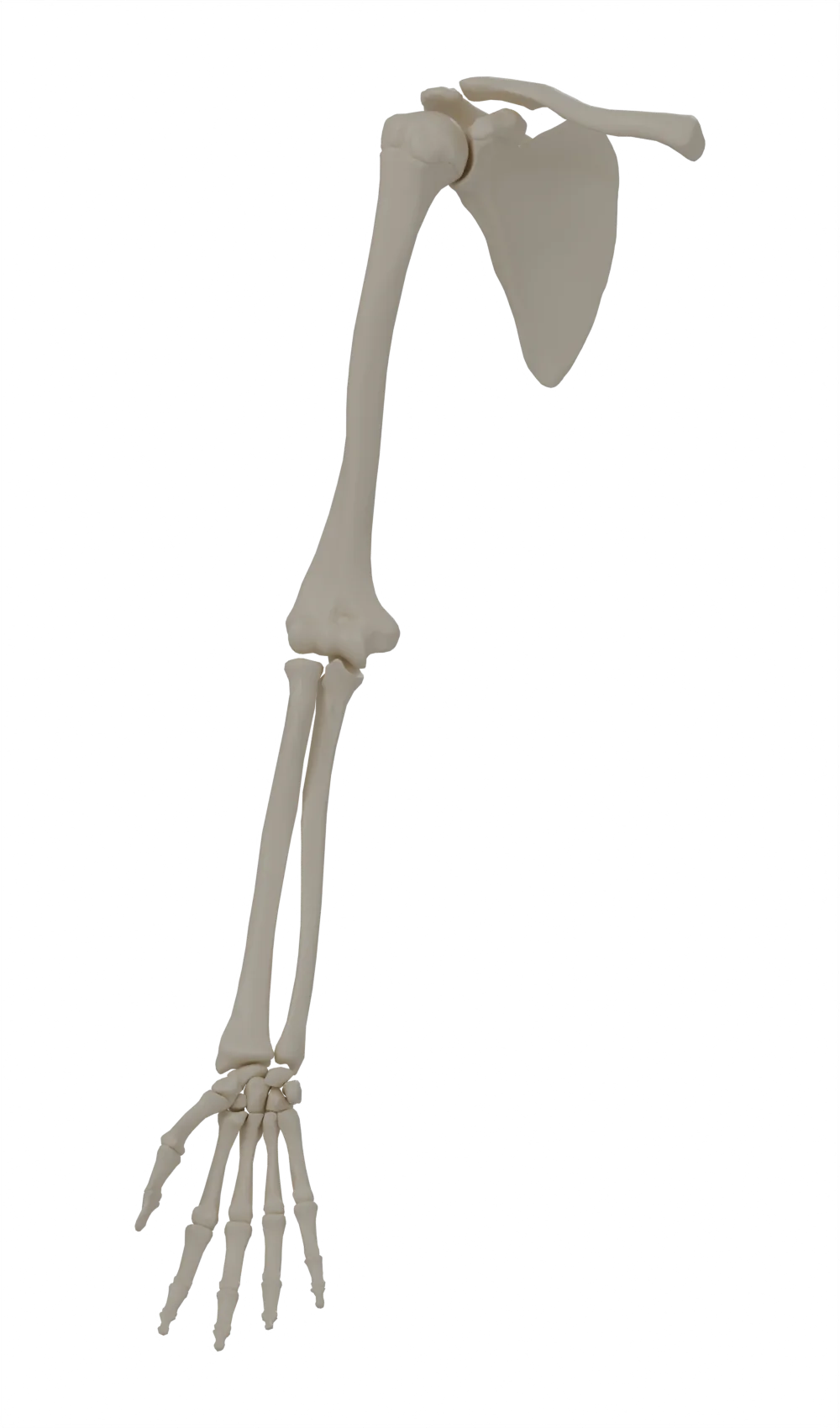
Right upper limb · anterior view
Axillary nerve
C5–C6
01Map · Where it is, what it relates to
Winds around the surgical neck of the humerus with the posterior circumflex humeral artery, after passing through the quadrangular space.
02Function · What it does
Supplies deltoid and teres minor, and the skin over the lower deltoid.
03Lesion · What you see when it is injured
Surgical-neck fracture or anterior shoulder dislocation: weak arm abduction, a flattened shoulder contour and a numb patch over the deltoid.
04Question · How it appears in the exam
After an anterior shoulder dislocation a patient cannot abduct the arm and has numbness over the deltoid. Which nerve?
Reveal the answer
The axillary nerve
Radial nerve
C5–T1
01Map · Where it is, what it relates to
Runs in the radial (spiral) groove on the back of the humeral shaft with the profunda brachii artery.
02Function · What it does
Supplies the extensors of the elbow, wrist and fingers, and the skin over the dorsum of the hand at the base of the thumb.
03Lesion · What you see when it is injured
Mid-shaft humeral fracture: wrist drop and numbness over the back of the hand. Triceps is usually spared because its branches leave above the groove.
04Question · How it appears in the exam
A patient with a mid-shaft humeral fracture cannot extend the wrist. Which nerve is injured?
Reveal the answer
The radial nerve
Ulnar nerve
C8–T1
01Map · Where it is, what it relates to
Passes behind the medial epicondyle of the humerus in the cubital tunnel: the “funny bone”.
02Function · What it does
Supplies most of the small muscles of the hand, and the skin of the little finger and half the ring finger.
03Lesion · What you see when it is injured
Medial epicondyle fracture: weak finger abduction and adduction, and a numb little finger. Clawing of the ring and little fingers is usually more marked when the injury is at the wrist than at the elbow (the “ulnar paradox”).
04Question · How it appears in the exam
After a medial epicondyle fracture a patient cannot grip a card between the fingers and has a numb little finger. Which nerve?
Reveal the answer
The ulnar nerve
Median nerve
C5–T1
01Map · Where it is, what it relates to
Crosses the wrist inside the carpal tunnel, under the flexor retinaculum, with the long flexor tendons.
02Function · What it does
Supplies most forearm flexors and the thenar muscles, and the palmar skin of the thumb, index, middle and half the ring finger.
03Lesion · What you see when it is injured
Carpal tunnel syndrome: tingling in the lateral three and a half fingers that is worse at night, weak thumb opposition and thenar wasting.
04Question · How it appears in the exam
Tingling in the thumb, index and middle fingers wakes a patient at night, with weak thumb opposition. Which nerve, and where?
Reveal the answer
The median nerve, in the carpal tunnel
Planned curriculum
What you’ll study
Module 0 builds the language, then region by region. Every region ends with a map, a question bank and an exam plan.
Planned curriculumLessons are in production; titles may change slightly before launch.
00Module 0 · Foundations6 lessons · The language anatomy is written in: position, planes, directions and movements.
1Anatomical position & body planes
2Directional terms that exams love
3Movements: flexion to circumduction
4Bones & joints: how they are classified
5Muscles: attachments, actions, innervation
6Reading a region: nerves & vessels as a map
01Upper Limb8 lessons · Shoulder, axilla and brachial plexus down to the carpal tunnel, with the four classic nerve injuries.
1Pectoral girdle & shoulder joint
2Axilla & the brachial plexus
3Arm compartments
4Cubital fossa & elbow joint
5Forearm compartments
6Wrist, hand & carpal tunnel
7Nerve injuries of the upper limb
8Blood supply & lymphatic drainage
02Lower Limb8 lessons · Hip, thigh, knee, leg and foot, and the nerves behind foot drop and a weak gait.
1Hip bone & hip joint
2Gluteal region & sciatic nerve
3Thigh compartments & femoral triangle
4Popliteal fossa & knee joint
5Leg compartments
6Ankle, foot & arches
7Nerve injuries of the lower limb
8Arterial supply & venous drainage
03Thorax7 lessons · Thoracic wall, pleura and lungs, mediastinum, heart and great vessels.
1Thoracic wall & intercostal spaces
2Pleura & lungs
3Mediastinum: a map in four parts
4Heart: surfaces, borders & chambers
5Coronary circulation
6Great vessels
7Diaphragm
04Abdomen8 lessons · Abdominal wall and inguinal canal, peritoneum, and the organs from stomach to kidneys.
1Anterior abdominal wall & inguinal canal
2Peritoneum & its spaces
3Stomach & duodenum
4Liver, gallbladder & biliary tree
5Pancreas & spleen
6Small & large intestine
7Kidneys & posterior abdominal wall
8Portal circulation
05Internal Organs: a systems view6 lessons · The same organs arranged by system, for universities that teach integrated blocks.
1Respiratory tract end to end
2Heart & great vessels in context
3GI tract: foregut, midgut, hindgut
4Urinary system
5Pelvic organs
6Endocrine glands: thyroid, adrenal, pancreas
06Head & Neck8 lessons · Skull and foramina, cranial nerves, triangles of the neck, larynx and thyroid.
1Skull & cranial foramina
2Cranial nerves I–XII
3Triangles of the neck
4Face & scalp
5Orbit
6Pharynx & larynx
7Thyroid & parathyroid
8Blood supply of the head & neck
Founding list
Start with the region your exam is on.
The first Medix enrollment. List members hear the opening date first and get the founding-student price.
Region Pass
Pick the region your next exam is on and try the method on it.
SAR49
Start with the region of your next exam
Every lesson of the region you choose
Module 0: Foundations
The printable Region Map
The region’s question bank with explained answers
A 7-day plan for this region’s exam
The full 49 counts toward Complete Anatomy if you upgrade within 14 days.
Enrollment isn’t open yet · Joining is free and commits you to nothing
Try it for 7 days. If it isn’t for you, get a full refund.
If you’ve opened no more than two lessons within 7 days of purchase, we refund you in full, no questions asked. We don’t promise you’ll pass; we promise clearer teaching. Refund policy
Who prepares it
Medical content led by a doctor.
S
Dr. Suhaib Alhaj
Medical content lead
Medix’s medical content is prepared under his lead, written to explain rather than to cut corners: every structure is tied to its function, to what happens when it is injured, and to how it is examined.
What we hold ourselves to
No invented reviews or inflated numbers
No fake countdowns or “limited seats”
Medix never replaces university or clinical training
Yes. The anatomy course starts with Module 0 (Foundations) and assumes no prior anatomy. Internal Medicine, OSCE and Emergency Medicine are aimed at the clinical years.
Is the content in Arabic or English?
Explained in Arabic, with the English terms your exams use. The idea is explained in Arabic so it makes sense, and the English term is kept because that is what you will see in lectures and exams. The site itself is available in both languages.
Can I study on my phone?
Yes. The platform is designed for phones first, and the files are laid out for both screen and print.
Are the lessons recorded?
Yes. Lessons will be short recorded videos you can watch any time, with files and questions for each lesson. The content is in production now, and enrollment is not open yet.
Does Medix replace university lectures?
No. Medix organises what you study at university and makes it easier to understand and revise. Your university’s curriculum, lectures and practical training remain the reference.
Does it match my university’s curriculum?
It covers the core anatomy medical schools teach, arranged by region, with an extra module arranged by system for universities that use integrated blocks. The full curriculum is on the course page; if yours differs, tell us.
Does Medix provide certificates?
No. Medix is a study resource, not an accredited body, so it does not issue certificates or CME hours.
How long do I keep access?
12 months from the date of purchase, including any updates to the course in that period.
Not ready yet?
Take the free plan and try the method.
A 7-day plan, the nerve map and 25 questions with explained answers.